Enter your numbers
Six fields. Add a body fat reading if you have one and the calculator switches to a better equation.
Your total daily energy expenditure is everything you burn in a day: staying alive, digesting food, moving around, and training. Fill in six fields and you get the number, a breakdown of where it goes, and an honest account of how far off it might be.
Fill in the form and your daily energy budget appears here, broken down into the four things your body spends calories on.

Runs in your browser the moment you press the button. No spinner, no server round trip.
No sign-up, no email wall, no upsell. Every result is on the page.
Four published equations, an error range beside the result, and safety limits built in.
Every equation and claim links to the paper it came from, on PubMed.
Three steps
Six fields. Add a body fat reading if you have one and the calculator switches to a better equation.
Your daily total, split four ways, plus calorie targets, macros, BMI and lean mass. Take it with you as an image or a PDF.
Eat at the estimate for two to three weeks and track a weekly average. Adjust by 100 to 200 calories if it drifts.
Getting it right
The equation is the easy part. Nearly all the error in a TDEE estimate comes from three places, and every one of them is under your control. Open whichever applies to you.
The activity multiplier does more damage than any other input. Jumping from light to moderate adds somewhere near 300 calories a day to your estimate, which is roughly the difference between losing half a kilo a week and losing nothing at all.
The trap is that a hard session feels like it should count for more than it does. What actually separates the levels is the whole week, including the parts you do not think of as exercise:
When you are torn between two levels, take the lower one. An estimate that is slightly low corrects itself in three weeks. One that is high leaves you wondering why nothing is happening.

Self-reported intake is unreliable in a way that surprises almost everyone. Studies that compare what people say they eat against doubly labelled water, which is the reference method for measuring energy expenditure, routinely find large gaps. The under-recording is not dishonesty. It is oil in the pan, the handful of nuts, the drink that nobody logs, and portions estimated by eye.
You do not have to weigh food forever. Two weeks with a kitchen scale calibrates your eye, and after that you can go back to estimating with some idea of how far off you are. Weigh things raw where you can, log the cooking oil, and count everything you drink.

Bodyweight moves for reasons that have nothing to do with fat. A salty meal, a heavy training session, glycogen, hydration and what is still in your gut can swing the scale by a couple of kilograms inside 48 hours. Reacting to a single reading means reacting to noise.
Weigh yourself under the same conditions most mornings, after the toilet and before eating, and average the week. Compare that average with the previous week's. If it has not moved after three weeks and you are confident about your logging, the estimate needs adjusting by 100 to 200 calories, not scrapping.
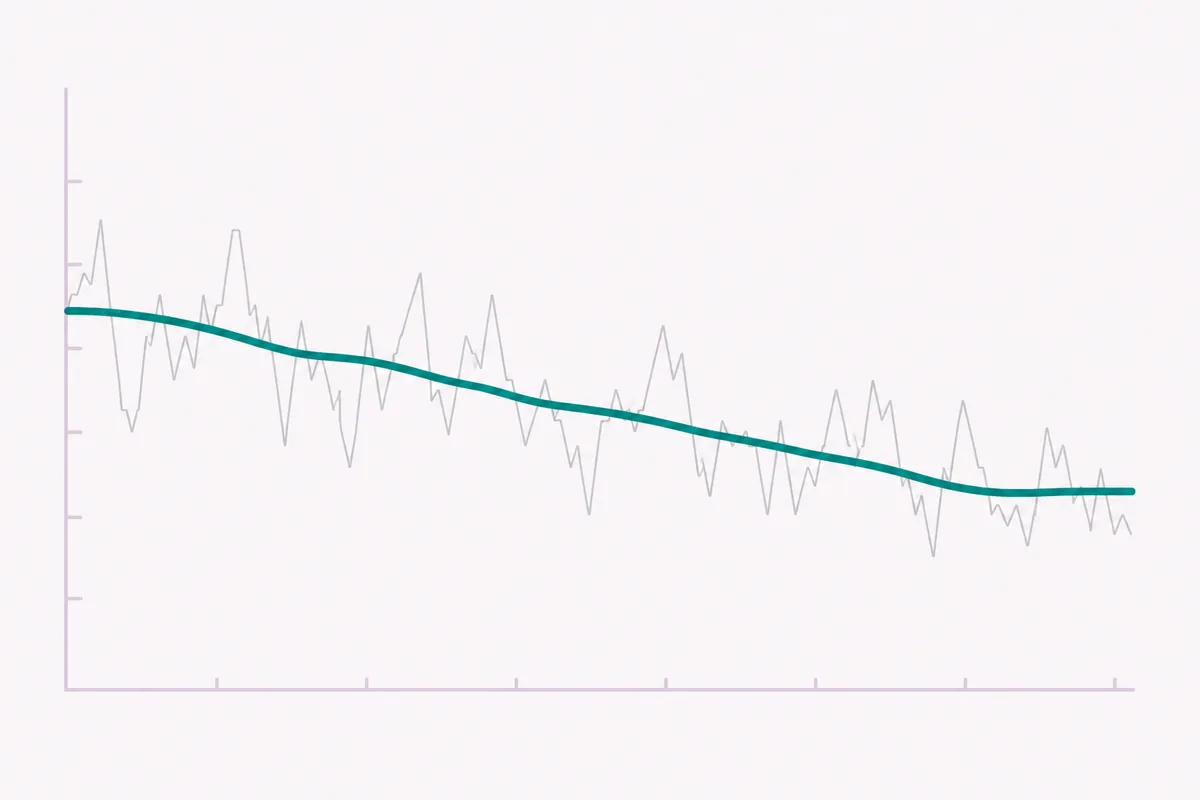
The four components
Total daily energy expenditure is a sum, and every calculator you will find works by estimating the first part and multiplying. Knowing what sits inside that multiplier tells you where you have room to move.
The cost of staying alive: heart, brain, kidneys, liver, breathing, holding body temperature. Easily the biggest line on the ledger, and it scales with lean tissue rather than total weight.
Everything that is not a workout: walking, cooking, standing, fidgeting, stairs. This varies more between two people of identical size than anything else, by hundreds of calories a day.
Breaking food down costs energy. Protein is the expensive one, burning perhaps a fifth of its own calories, while fat is nearly free. One reason higher-protein diets feel easier than the maths suggests.
Smaller than most people expect. A hard hour might cost 400 calories, roughly a bagel with cream cheese. Exercise earns its place through health and strength more than through calories burned.
Add the four together and you have your TDEE. No calculator measures any of them. They estimate the first from your height, weight, age and sex, then apply a multiplier standing in for the other three. That is the whole trick, and it explains both why these tools work and where they go wrong.
Under the hood
There is no single correct formula. There are several, published over the last century, each fitted to a different group of people. This calculator runs yours through all of them so you can see the spread rather than a false point of certainty.
| Equation | Formula | Where it fits |
|---|---|---|
| Mifflin-St Jeor 1990 |
Men: 10W + 6.25H − 5A + 5Women: 10W + 6.25H − 5A − 161 |
The default here, and the one dietitians reach for. A systematic review of the four equations in common clinical use found it landed within ten percent of measured resting metabolic rate more often than the others, with the narrowest error band.2 |
| Harris-Benedict 1919, revised 1984 |
Men: 88.362 + 13.397W + 4.799H − 5.677AWomen: 447.593 + 9.247W + 3.098H − 4.330A |
The original, still quoted everywhere. It was built on a small, lean, early twentieth century sample and tends to run high for modern bodies, typically by five percent or so.3 |
| Katch-McArdle | 370 + 21.6 × LBM |
Ignores height, weight, age and sex entirely and works only from lean mass. If you have a credible body fat reading, this is the better estimate, and the calculator switches to it automatically. |
| Cunningham 1991 |
500 + 22 × LBM |
Also lean-mass based, and it reads a little higher than Katch-McArdle. Popular in sports nutrition, where athletes often measure above what the general-population equations predict.4 |
The five steps this calculator uses (1.2, 1.375, 1.55, 1.725 and 1.9) are the standard set, and they are blunt instruments. One number cannot separate a builder who trains twice a week from an accountant doing the same sessions, though their daily totals differ by hundreds of calories. This is where nearly all the error creeps in, and people reliably pick a step too high.
What to do next
Eat at your estimated maintenance for two to three weeks, weigh yourself under the same conditions most mornings, and take the weekly average. If the average is flat, the estimate was good. If it drifted, adjust by 100 to 200 calories and repeat. After a month you will have something no equation can give you, which is your own measured intake.
Day-to-day weight is mostly water, glycogen and gut contents, and it can move by a couple of kilograms for reasons that have nothing to do with fat. Averages over a week are the only readings worth reacting to.
A deficit of 500 calories a day is often quoted as a pound a week, which comes from a rule of thumb that treats fat as 3,500 calories a pound. That rule overstates long-term loss, because expenditure falls as you get smaller and lighter. The more careful models predict weight loss that decelerates and eventually plateaus at a new, lower maintenance level.5
Aiming for around 0.5 to 1 percent of bodyweight per week is a reasonable ceiling for most people. Faster than that and you lose more lean tissue, feel worse, and are more likely to quit.
Two things reliably preserve muscle in a deficit: enough protein and resistance training. The meta-analytic evidence puts the point of diminishing returns for protein at roughly 1.6 grams per kilogram of bodyweight per day in trained people, with the confidence interval reaching to about 2.2.6 Going far beyond that is not harmful for healthy kidneys, it is just unnecessary.
As you lose weight your expenditure falls, partly because there is less of you to carry and partly because of an additional drop beyond what body size alone predicts.7 Recalculate every 4 to 5 kilograms, or whenever progress stalls for three or four weeks at a compliance level you are confident about.
Honest limits
For a typical adult, a good prediction equation gets within about ten percent of what indirect calorimetry would measure. On a 2,400 calorie day that is a window of roughly 240 calories in either direction, which over a month is enough to explain a kilogram of unexpected weight change.
The error is not evenly distributed. Estimates drift furthest for people at the extremes of body size, for older adults, and for ethnic groups who were underrepresented in the original validation work, a gap the authors of the main systematic review named explicitly.2 Illness, medication, thyroid function and pregnancy all shift resting metabolism in ways no height-and-weight formula can see.
None of that makes the number useless. It makes it a starting point. Every serious approach to this works the same way: estimate, observe, correct. The calculator handles the first step, and the other two are yours.
Sources
Every claim about metabolism on this page traces to one of the following. Links open on PubMed and are marked nofollow.
Written by: the TDEENet team Last checked against sources: How we source and review
Questions
BMR is measured under strict conditions: fasted, fully rested, lying still in a controlled room. RMR is measured under more relaxed conditions and comes out roughly 10 percent higher. In practice the two get used interchangeably, and the equations on this page were mostly derived against resting measurements. TDEE is the whole day, BMR plus everything else you do.
Think about the whole week, not your best day. Three genuinely hard sessions is moderate. Seven light walks is not heavy. If your job keeps you on your feet all day, move up a step even if you never see a gym, because standing and walking are where the non-exercise component lives. When you are torn between two options, choose the lower one and let your weight data promote you.
Usually one of three things. The estimate is high, most often because activity was overstated. Intake is higher than recorded, which is extremely common: studies of self-reported eating find people routinely under-record by a wide margin, especially with cooking oils, drinks and anything eaten standing up. Or not enough time has passed for the signal to show through normal water-weight noise.
Weigh your food for two weeks rather than estimating portions. Most people find the gap that way, and it is nearly always larger than they expected.
BMI divides weight by height squared and has no way of knowing what that weight is made of. A muscular person and a sedentary one at the same height and weight get the same score. It was designed for describing populations and performs poorly on individuals, a limitation that has been documented at length.8 If you lift and your BMI reads high, a body fat measurement will tell you far more.
No. Weight change is driven by energy balance, and you can create a deficit through diet alone. What exercise does is preserve muscle while you lose, improve cardiovascular and metabolic health, and make maintenance easier afterwards. Resistance training in particular changes what you lose rather than how much.
Beyond hitting adequate protein and enough fat for hormone and vitamin needs, the split matters much less than total calories and consistency. Controlled trials comparing low-carbohydrate and low-fat diets at matched calories and protein tend to find small differences that fade over time. Pick the pattern you can hold for a year.
Every 4 to 5 kilograms of weight change, or roughly every two months if your weight is stable and your training has changed. Recalculating every week gives you noise, not information.
No. The calculation runs entirely in your browser. Nothing you enter is transmitted, logged or saved, and closing the tab discards it. See the privacy policy for what the site does collect, which is very little.